The medical question
Can a baby really be born with a mustache?
Short answer: not this one. Newborn hair is real, common and nothing like the clip. Here is what lanugo actually is, what else can cause excess hair, and what parents are advised to do.
7 min readUpdated 25 Oct 2026Not medical advice
Almost every explainer about the baby with mustache video reaches the same paragraph: babies can be born with hair, it is called lanugo, and it disappears. All true. It is also the least interesting part of the answer, because lanugo looks nothing like an adult mustache — and that difference is the whole reason the clip is funny.
What lanugo actually is
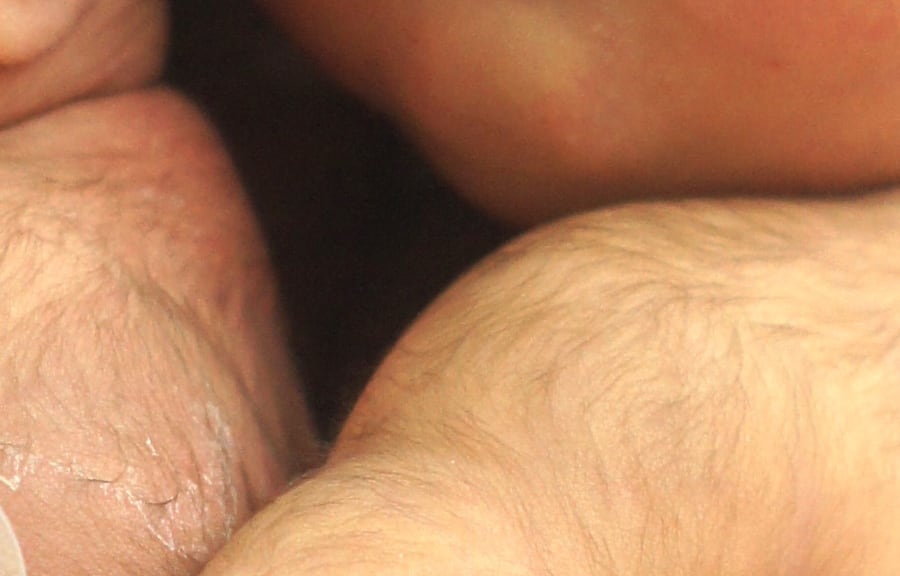
Lanugo is the first hair a human grows. It develops in the womb, covers the fetus, and is mostly gone by the time a full-term baby is born. It is soft, short and lightly pigmented — closer to the fuzz on a peach than to hair that needs a comb.
Weeks 16–20
Lanugo appears
Fine, soft hair starts covering the fetus. It grows everywhere except the palms, soles and lips, and it helps hold the protective vernix caseosa against the skin.
Weeks 24–32
Peak coverage
Coverage is thickest in this window. On an ultrasound or a very premature birth, this is the hair you see — pale, wispy and evenly spread rather than concentrated in a style.
Weeks 33–40
Most of it sheds
As the fetus gains fat, most lanugo falls away into the amniotic fluid, which the baby swallows. By term, only traces usually remain.
First weeks after birth
The leftovers disappear
Any lanugo that survives birth — most often on premature babies, typically on the back, shoulders, ears and cheeks — rubs off on its own within weeks.
Lanugo versus the clip
Put the two side by side and the problem becomes obvious. Lanugo is a texture; the clip shows a haircut.
| Feature | Lanugo | The viral mustache |
|---|---|---|
| Thickness | Fine, wispy, individually visible | Dense, opaque, reads as a solid mass |
| Pigment | Pale to lightly coloured | Near-black, matching scalp hair |
| Distribution | Even over back, shoulders, ears, cheeks | Concentrated above the lip, plus a chin patch |
| Borders | Fades gradually into skin | Hard, symmetrical outline |
| Behaviour | Rubs off over weeks | No follow-up footage has ever appeared |
The rare condition people keep mentioning
Congenital hypertrichosis is a real genetic condition causing excessive hair growth. It is genuinely rare, it can affect the face, and it is frequently invoked in comment sections as the “maybe it’s real” explanation.
The detail that gets dropped: hypertrichosis usually produces lanugo-like hair over a broad area, not a compact, symmetrical, sharply outlined mustache with a matching goatee. It also tends to be visible from birth onward and to persist, which is the opposite of a clip that has no follow-up at all.
This matters for a second reason. The condition is a real thing that real families deal with, and using it as a punchline or as proof in a meme argument is unkind to people who actually have it. The joke belongs to the edit, not the diagnosis.
Hormones, medication and contact
- Minoxidil contact. A topical hair-growth product used by some adults can affect a baby’s skin after repeated contact. Hair growth usually recedes once exposure stops.
- Diazoxide. A medication used for certain metabolic disorders has been associated with increased hair growth in infants; the effect typically reverses after the drug is stopped.
- Hormonal factors. Newborn hair patterns can be influenced by maternal hormones, though this normally shows up as temporary body hair rather than styled facial hair.
What parents are actually advised to do
- Do not shave, pluck or wax. Newborn skin is thin enough that removal does more harm than the hair ever could.
- Photograph it and note the date. If you end up seeing a clinician, a timeline is more useful than a description.
- Ask a paediatrician if growth is unusual or increasing. Most cases need no treatment at all; the point of the visit is to rule out something that does.
- Ignore the internet. Specifically, ignore anyone who diagnoses your child from a five-second clip. That includes this website.
What this means for the clip
Lanugo explains why “a baby with hair” is not automatically fake. It does not explain the clip. The hair in the video is too dark, too dense, too shaped, and — most tellingly — too badly attached to the face it is supposed to be growing from.
The medical question and the forensic question have the same answer here, reached from opposite directions: newborn biology can produce hair, but not that hair.
Sources
- 01Un video de un bebé con vello facial se ha vuelto viral
Ecuador Al Día 365 (@ecuadoraldia365) on X · Oct 23, 2026, 13:35 UTC
The original post: a 5.4-second clip, now over 10 million views, with a reader-added note disputing the medical framing.
- 02It is false that a video shows a newborn baby with a mustache
Boatos.org · Oct 24, 2026
Closest thing to a verdict: reports the facial hair shifting and briefly vanishing as the baby moves.
- 03Bebé con barba y bigote: el video viral
Metro Ecuador · Oct 23, 2026
Local reporting; notes that a doctor's name shown on screen could not be matched to any physician.
- 04'He was born retired, with 3 kids and 2 mortgages'
WION · Oct 24, 2026
Catalogues the flicker and lighting objections, plus the first wave of meme edits.
Read next
Updated October 25, 2026. Corrections are published at the top of the page, not edited in silently.